





3100+ Successful Students

Read-A-Rific: Help Your Child To Understand And Remember What They Read In 15 Minutes A Day

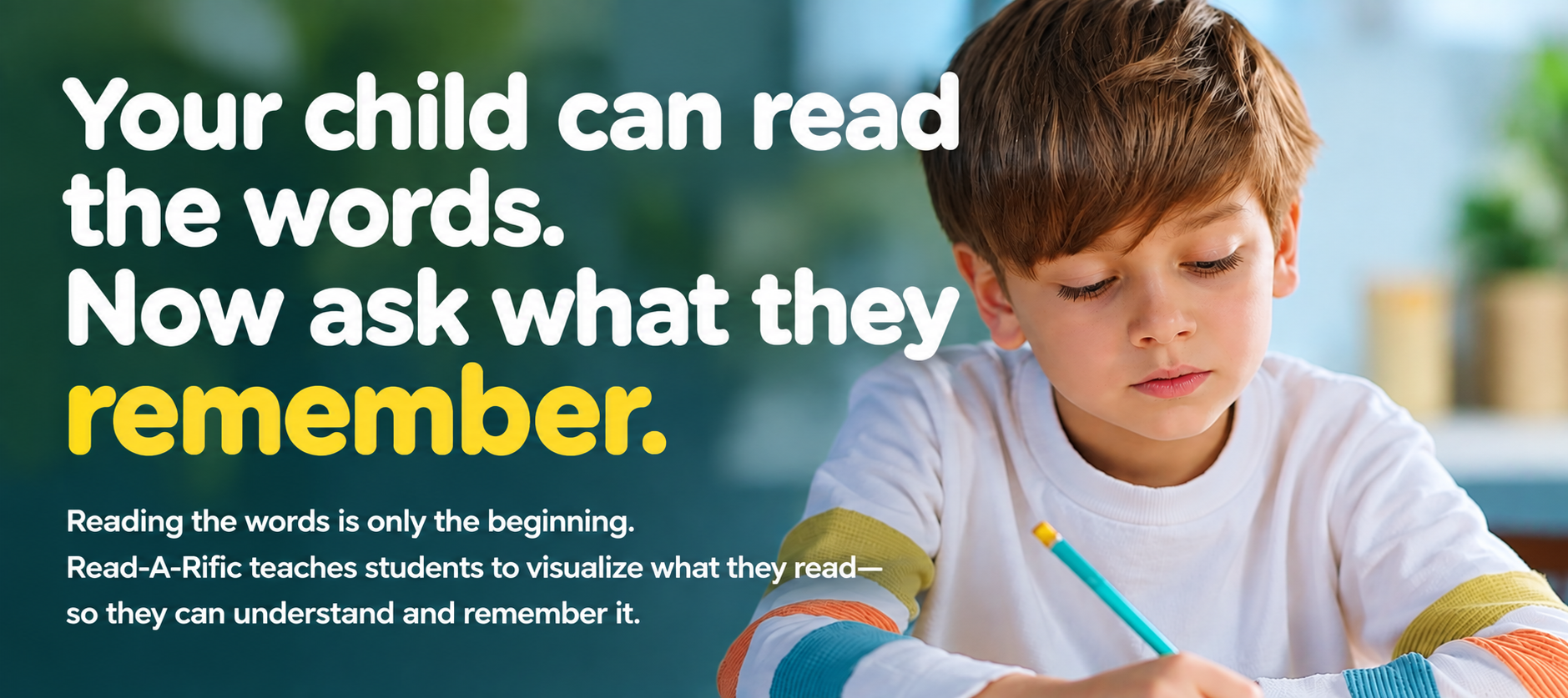
If your child reads but doesn’t understand or remember…

If homework takes too long …

If your child struggles with reading comprehension despite trying hard…

There is often a deeper reason.

Many struggling learners have never been taught the important foundational skill that makes comprehension, memory, and independence possible.

That skill is visualization — the brain’s ability to create meaning from what is heard and read.

Discover how this approach works — and how to begin supporting your child at home.

Reading Image

Go From This…..

Struggling with listening or reading comprehension, poor speller, difficulty following directions, inattentive, low confidence, poor self-esteem, frustrated with schoolwork, or doesn’t feel smart.

To This!

Understanding and remembering much more of what is heard and read, improved spelling, able to follow directions, increased attention, improved confidence and self-esteem, and more!

Our Expert Can Help You!

Let our founder and developer, Janel Nansenn, M.A., Educational Therapist, take you step-by-step through the process of transforming your student into a confident learner.


See a video review about our reading comprehension program by Amanda Melrose of eSchooled here.

Why So Many Children Struggle with Reading Comprehension

Over the years, many parents have come to me asking the same questions:

  • Why does my child struggle with remembering what they read?
  • Why do they read the words but not understand what they’ve read?
  • Why does homework take so long?

Most students who struggle with reading comprehension often work harder than their peers. This is because they lack the important foundation that allows the brain to understand and remember what is read or learned.

When that foundation is underdeveloped, a child may:

  • Forget what they read soon after finishing
  • Need directions repeated several times
  • Struggle to organize thoughts in writing
  • Feel frustrated during homework
  • Lose confidence in their abilities

Why So Many Children Struggle with Reading Comprehension

That missing piece is visualization — the brain’s ability to create mental images from what is heard and read.

Visualization plays a central role in reading comprehension. When students visualize while reading, they are not just reading words — they are actively creating meaning.

Example: When a student reads, “The cat walked toward the barn,” strong comprehension depends on their ability to form a clear mental picture. That mental picture helps the brain organize and store information.

When students consistently develop visualization skills, you’ll often see:

  • Comprehension become clearer
  • Memory strengthen
  • Writing become more organized
  • Directions become easier to follow
  • Learning feel more natural

Most schools test comprehension. Few explicitly teach kids to visualize while reading.

Hispanic girl using visualization strategies to improve reading comprehension

When Comprehension Feels Hard, Confidence Often Follows

When a child consistently struggles to understand or remember what they read, it doesn’t just affect academics. Over time, many students begin to question themselves.

“I’m not good at this.”

“I can’t remember anything.”

“I just don’t like school.”

Homework becomes tense. Avoidance increases. Confidence quietly erodes.

And that emotional shift is often more concerning than the grades themselves.

But when the underlying skill strengthens, something important changes:
students begin to feel capable again.e at least 7½ years old to benefit.

Start Here: Watch the Free Video

If you’d like to understand the root cause first, start here.

  • Why many struggling readers work hard but still don’t retain
  • How visualization changes the learning process
  • What most traditional approaches overlook
  • What you can begin doing right away

If You’re Ready for Structured Support

I’ve developed a step-by-step online reading comprehension program that teaches this foundational skill in short, guided sessions — approximately 15 minutes a day.

This is not about adding more practice. It’s about strengthening the process behind comprehension.

Many parents come to this program after trying:

  • Reading together every night
  • Extra tutoring
  • Repeating directions
  • Incentives and reward systems

Those efforts often focus on performance. Visualization focuses on foundation.

Overview Video of a Lesson

Watch this video of our founder and developer, Janel Nansenn, M.A., Educational Therapist, give an overview of a lesson from the Read-A-Rific® Reading Comprehension program.

Read-A-Rific®

A Structured Reading Comprehension Program for Kids

Read-A-Rific® is an easy-to-follow online reading comprehension program designed to teach students how to strengthen visualization step-by-step.

As students develop this foundational skill, they begin to:

  • Understand and remember what they read
  • Follow directions more independently
  • Improve spelling and written organization
  • Feel more capable and confident in their learning

What each grade-level program includes:

  • 60 guided sessions
  • Approximately 15 minutes per day
  • Step-by-step instruction in visualization
  • Practice applying visualization to reading passages
  • Support for memory, spelling, and multi-step directions
  • Unlimited Access

Designed to be simple to follow, with minimal parent preparation required.

What Parents Often Notice Over Time

As students strengthen their visualization skills, families often begin to notice steady, meaningful changes.

  • Reading comprehension improves
  • Homework becomes more manageable
  • Students retain more of what they learn
  • Concentration improves because information makes sense
  • Writing becomes more organized
  • Spelling and memory strengthen
  • Students work more independently
  • Confidence begins to return

These shifts don’t come from more pressure or repetition.

They come from strengthening the foundation behind comprehension.

Meet the Educational Therapist Behind the Program

About Janel Nansenn, M.A.

I am an Educational Therapist with over 25 years of clinical experience. I’ve owned five successful private practices across four states and have helped students succeed academically — even when traditional approaches did not produce results.

Read-A-Rific® was created to translate proven in-person techniques into a structured, accessible online format so more families can benefit.

Every child deserves to feel capable and confident in their learning.

If you believe your child may be missing this foundational skill, the next step is simple:

“Once we started using Read-A-Rific® Kannon’s grades went up drastically. He went up one full grade level in reading and his confidence has increased ten fold.”

Research Supporting Visualization and
Reading Comprehension

Research has consistently shown that visualization plays a meaningful role in reading comprehension and memory.

A 2023 study published in Reading Psychology (Moretti & Musso) found that many elementary students struggle with consistent visualization while reading — impacting comprehension and recall.

Earlier research by Pressley (1977) demonstrated that students who are taught to visualize while reading show stronger recall than students who are not explicitly taught this strategy.

These findings support what decades of educational therapy experience have shown: visualization is not automatic for many students — and when it is taught directly, comprehension improves.

WHAT MAKES THIS DIFFERENT

Read-A-Rific® is not a typical reading comprehension program.

It teaches students how to learn, not just what to read—by strengthening the brain’s ability to process, organize, and remember information.

This approach supports learning across subjects, not just reading.

NOTE: This page is intended for ClassWallet purchases only.

If you would like to explore additional information, videos, or resources, visit www.readarific.com.